Digital Debunking: The Truth About Captain America's Bouncing Shield
Comics and engineering have always shared a tight relationship. Tony Stark, an engineer with disabilities, dreamed an exosuit could make him a hero. Today, engineers test similar exosuit designs that help some lift beyond their means and — more amazingly — others walk with paralysis. The truth is that countless technologies from smartwatches to wingsuits can all be traced back to comic book origins.
But this inspirational pendulum pushes both ways. Stories of a sympathetic engineer, good and evil, building a device to save themselves, loved ones, or society has become a trope spanning many comic characters from Mr. Freeze, to Mr. Fantastic and even Lex Luthor.
 |  |
But as inspiring as these stories are sometimes — scientifically speaking — they are flat out bonkers. So, with Stan Lee’s birthday on the horizon (December 28th by the way), let us use Altair® Inspire™, Altair® HyperMesh® and Altair® Radioss® to test out a hotly debated physics-in-comic-books phenomenon: Captain America’s ricocheting shield made from a “vibranium-steel alloy.”
Engineering Research on Captain America’s Shield
Since the very first Captain America comic (back in 1941), the titular character sported a patriotic shield. But it was not always portrayed as a frisbee that pretends the entire world is its billiards table. In the first edition it was not even round!
By the third release of the comic, Stan Lee added a two-page short story that describes, for the first time, how the new round shield (introduced in the previous issue) was thrown like a spinning disk.
However, in 1960’s Avengers #5, Lee and his long-time partner Jack Kirby first depict the shield ricocheting off multiple objects only to eventually return to Cap’s hand. Since then, this bouncy-ball-like fighting style has become a trope featuring everything from “legendary heroes obsessed with golden triangles,” to “warrior princesses taking on the Greek pantheon.”
For Captain America, this particular flavor of the trope is made possible thanks to the shields’ vibranium-steel alloy. What is Vibranium? Good question: it does not exist. But in Marvel comics and movie lore it is described as a metal that can perfectly absorb, and safely store and/or dissipate, kinetic energy. Thus, this mythical metal is what makes the weapon as springy as a squash ball. Finally, the lore notes that Cap’s shield is stronger than steel and a third the weight.
Assembling the First Avenger’s Engineering Model
The geometry for the shield was built in Inspire, a CAE tool that offers simulation and computational physics within a CAD-like environment. The dimensions were estimated based on reference images, proportional scaling and scenes from the Marvel films.
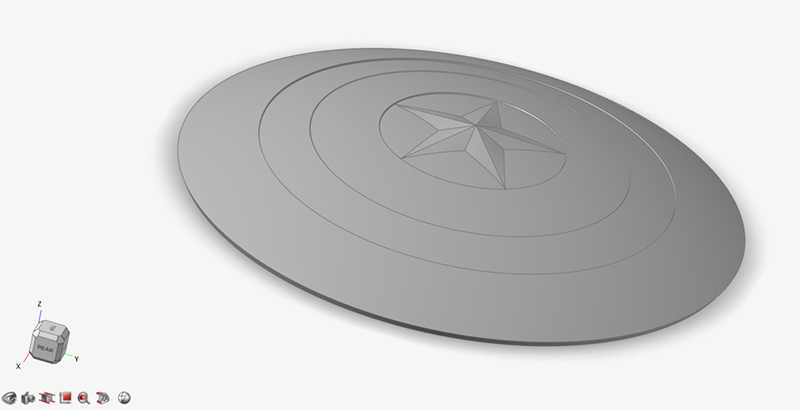
The geometry was then optimized for the meshing process (a key step of the simulation workflow). The mesh was made using HyperMesh — a finite element analysis (FEA) software that streamlines the setup, build, run, visualization and analysis of physics-based models.
Finally, the Radioss solver was used to calculate the physics involved with the shield impacting various walls. This solver is an industry proven physics modeling tool used to assess crashes, impacts, blasts and other nonlinear scenarios.
When exact material properties are stated in comics and movie lore (like one third the density of steel) these values were used in all simulations. Then, for the first run of the experiment, the material properties of ultra-high strength steel (UHSS) were used as a baseline. In subsequent experiments UHSS material properties were adjusted based on inexact vibranium descriptions within the lore. For example, the yield strength and Young’s modulus were adjusted based on statements like “stronger than steel.”
The initial simulations assumed the system had rigid walls and flooring that were set up orthogonally. For a proof-of-concept analysis, the distance between the walls was kept short, about the size of an average closet. The shield was then tested in a larger room to assess how fast it must be thrown to make it back to Cap’s hand.
Other data points and assumptions, like the coefficient of friction between the walls and the disk were estimated using common “ballpark” numbers and traditional methods. For instance, the law of reflection was assumed to describe the direction of the shield after each impact. Finally, the speed and rotation of the disk were adjusted and tested to maximize stability and to ensure the final positions are as close as possible to the initial positions (aka Cap’s hand).
Not so Indestructible After All — Yet…
In all simulations the impacts send stress waves through the shield. Thus, after each collision the system gains more flutter and deformation. This makes sense as if the shield absorbs all the energy then that energy must go somewhere. If the walls were not rigid, they would experience some damage — you would not want to be in the way of Cap’s toss. Nonetheless, the flutter and deformations show that the shield, if made from steel, fails to perform as in the comics and films.
Initially, shield thickness was altered to attempt to make the geometry sturdier. But this quickly developed into another problem. More material means more weight and the amount of material needed to make the disk survive the impacts eventually brought the mass to a point where people could not lift it — let alone toss it. Unfortunately, Captain America’s superstrength cannot explain this away, as both the movies and comics show various individuals without superpowers lifting, and even tossing, the shield with ease.
So, to further reduce flutter and deformation (and to make the material more vibranium-like), the stiffness of the metal was adjusted in subsequent simulations. At first a stiffness twice that of steel was tested. Then a material ten times as stiff as steel was assessed. These simulations certainly reside “in the realm of science fiction.” There are no materials currently available that check all these boxes. However, it is not fully inconceivable that a potential material could be discovered, or engineered, to one day have all these properties.
The challenge comes when the shield is tossed in a larger room. To move around the room and return to Cap’s hand it will need to be tossed at highway speeds. This is self-defeating as the more speed you add the more damage the shield takes on. Eventually, you again get to the point that the weight needed to survive the impacts make the shield so heavy that de-powered heroes cannot toss it around.
In conclusion, Cap’s shield bouncing technique seems to live at the edge of human possibility. So, for now, this is fully debunked.
Until next time true believers, and happy birthday Stan the Man. You did the engineering world a service.
For more on the simulation of Marvel lore, read Thor’s Hammer with a little Simcenter HEEDS-Ooomph!
All product and company names are trademarks™ or registered® trademarks of their respective holders. Use of them does not imply any affiliation with or endorsement by them.