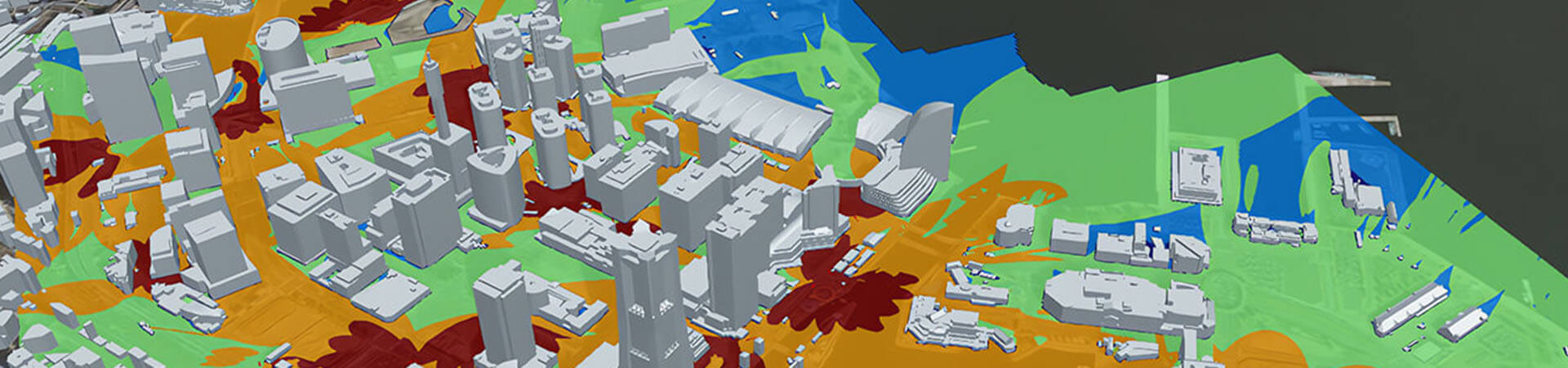
A section of the output Altair Feko simulation of radio propagation used on existing 3D city data for the Yokohama Minato Mirai 21 area.

Yokohama Minato Mirai 21 Corporation

How Can High-Precision Simulation Plan the Optimal Placement of Local 5G Base Stations?

The following is extracted from Jichitai Works Vol. 24, and translated into English by Altair (published on February 2023, with the article written after the interview).


5G communication will be extended throughout the area without relying on carriers.

5G is attracting attention as a next-generation telecommunications infrastructure, and the development of a high-speed, high-capacity telecommunications environment is expected to bring major changes in disaster prevention, business, social services, and much of daily life. The city of Yokohama, which declared itself "Innovation City Yokohama" in January 1991, is aiming to create innovation through a three-way collaboration between industry, academia, and government. Part of this collaboration is the development of a 5G communications environment, which will enable the kind of next-generation innovation the city prides itself on.

However, 5G radio waves are very linear are thus easily blocked by obstacles. Currently, most areas in Japan are dependent on major telecommunications carriers for 5G installation, but signals can be weak if base stations are far away from each other or if the area is lined with buildings. For this reason, the city of Yokohama has begun studying the possibility of establishing a "local 5G" environment “in which we can install our own base stations and strengthen the signal without relying solely on carriers," said Mr. Takumi Watanabe, a member of Yokohama Minato Mirai 21 Corporation (YMM21), an affiliated organization of the city of Yokohama, and a member of "Yokohama Future Organization," a voluntary organization that aims to create a model of a future city. YMM21 is working together with the Yokohama Future Organization to create the 5G project.

An efficient way to build new base stations is to install "smart poles," which can be equipped with wireless equipment, sensors, streetlights, and so on. However, each pole costs several million yen, so it’s challenging to install many poles. The main challenge for this project was how to make the invisible radio waves visible. In February 2022, YMM21 completed an agreement with Altair Engineering, an American global company that provides software and cloud solutions in simulation, high-performance computing (HPC), data analytics, and artificial intelligence (AI), to conduct 5G radio propagation simulations in Yokohama’s Minato Mirai 21 area. The company has several products that provide robust 5G network visualization and planning capabilities, including Altair® Feko® and Altair® WinProp™.
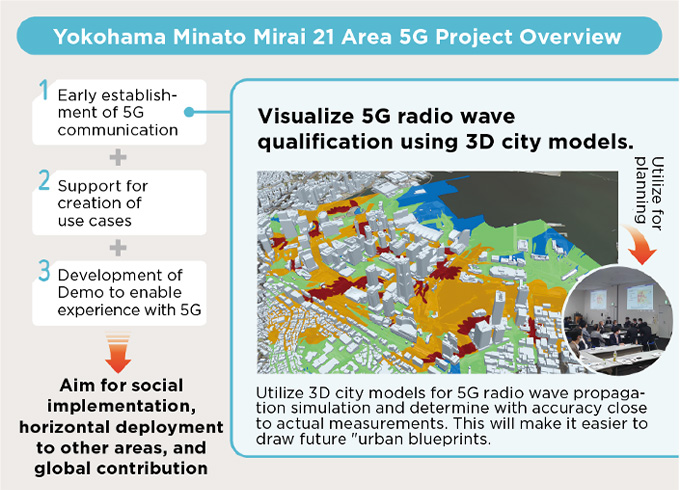
The simulation is based on the Ministry of Land, Infrastructure, Transport, and Tourism 3D urban model.

“We began exchanging views with the company several years ago. At that time, the Ministry of Land, Infrastructure, Transport, and Tourism had started a 3D city modeling* project, which made it possible to obtain detailed city data on which to base our simulations,” Mr. Watanabe said. “Initially, there were plans to build our own simulation tool, but we were able to start early as a demonstration experiment using Altair technology and a 3D city model.”

A flowchart graphic depicting the steps taken during the Yokohama Minato Mirai 21 Area 5G project. Step 1: Visualizing 5G radio wave qualification using 3D city models created with Altair Feko. Step 2: Establishing support for the creation of use cases. Step 3: Developing a demo to enable experiences with 5G.

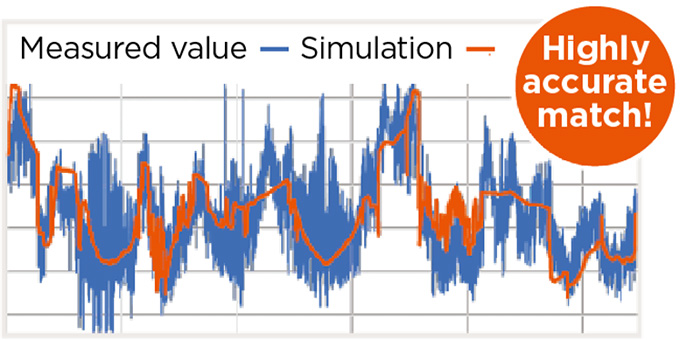
In urban areas, where buildings of various heights and shapes are lined in complex rows, the propagation of radio waves is difficult to predict. After conducting simulations, a survey was conducted in November 2022 to measure radio wave propagation in a portion of the area. It was found that the influence of buildings could be predicted fairly accurately. On the other hand, it was also found that roadside trees and traffic signals affect radio propagation. Adjustments were made to fill in the differences, and the simulation is now more accurate.

The project's "PLATEAU" website also introduces case studies.

*Urban data that creates 3D maps based on basic urban planning surveys, etc., with attribute information attached to the buildings and land on the maps. Currently, 56 cities have been mapped, with plans to expand to approximately 500 cities by FY2027.

It also aims to support startups as a field for demonstration experiments.

While making these preparations, YMM21 and Altair are actively holding 5G utilization workshops and events, as well as soliciting ideas. When asked about their aims, Mr. Watanabe replied, "The development of a local 5G environment that we are working on is also the creation of a ‘demonstration experiment environment’ for urban innovation. This simulation is one of the foundations for this. In parallel, we plan to support not only major companies, but also startups in the development of 5G solutions," he said.

Through a series of initiatives, Mr. Watanabe, believes that future urban development will require a "networked environment" approach. “A network environment will be indispensable for the utilization of new services and technologies not only in urban areas, but also in rural areas,” he said. “We will continue to disseminate information about our efforts in this area so that it can be used as a model case for horizontal development.

Capable of meeting the different needs of each municipality

What each municipality wants to achieve with 5G should be different. Altair can propose the best network construction plan to meet the needs of each municipality, even those that have not yet developed a 3D city model.

We will seek a convenient “future vision of the city” in anticipation of changes brought about by high-speed, large-capacity communications.


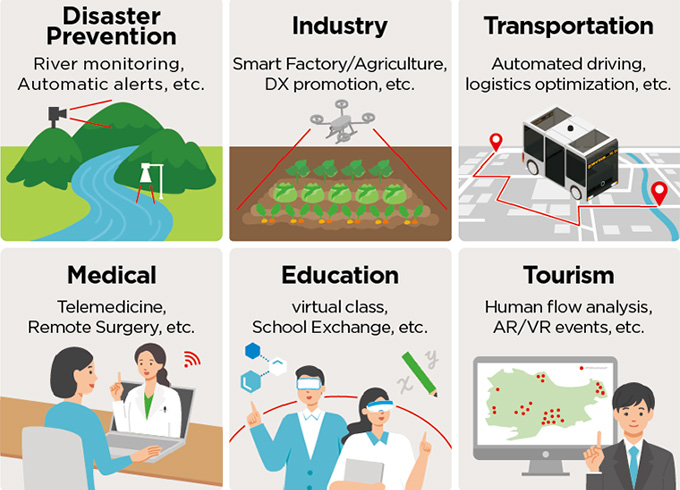
Examples of 5G-Enabled Innovations

The establishment of a communications infrastructure with radio waves of sufficient strength to reach every corner of a city will bring many next-generation technologies closer to realization, such as the spread of Internet of Things (IoT) devices and the promotion of autonomous driving technology.

Infographic displaying six examples of 5G-enabled innovations: disaster prevention via monitoring and alerts, smart-technology within industries such as manufacturing and agriculture, transportation optimization, remote medical services, virtual education, and tourism analysis.

Simulations make it easy to formulate concrete measures.

1. Significantly reduced costs and timeframes

While actually measuring radio waves would require a considerable amount of equipment and manpower costs, simulation technology enables speedy, cost-effective responses.

Illustration of three people looking at a laptop, with a lightbulb icon signifying a new idea.

2. Highly accurate prediction of the radio environment

By utilizing 3D city models, teams can predict the reach of 5G radio waves, the signal strength and weakness of each area, and optimal base station placement.

A graph displaying the comparison of measured versus simulated radio waves in the Yokohama Minato Mirai 21 area, which resulted in a highly accurate match.

Comparison of measured and simulated radio waves in the Yokohama Minato Mirai 21 area.

Graphic that reads: