Digital Debunking: Doc Brown's Survival in Back to the Future
The Story
On a fictional morning of November 5th, 1955 (or October 26th, 1985, depending on your point of view) Marty McFly made his time traveling debut. Now stuck in the past, he enlists the help of Doc Brown, soon-to-be inventor of his time machine, and his “then” teenage parents to fix his broken timeline and send him “back to the future“!
But something always felt off with the movie’s ending — beyond the obviously heinous parking scenes.
During Marty’s triumphant return home the Delorean, fitted with a metal hook, strikes a cable, connected to Hill Valley’s Clock Tower, at the exact moment it is electrified by lightning, and the time machine reaches 88 mph. This OSHA-violation-on-wheels completes a circuit powering Marty’s trip back to 1985. Eagle-eyed viewers will notice that the lightning hook “safely” detaches from the car and remains hanging from the wire, back in 1955, with nothing but a light sway.
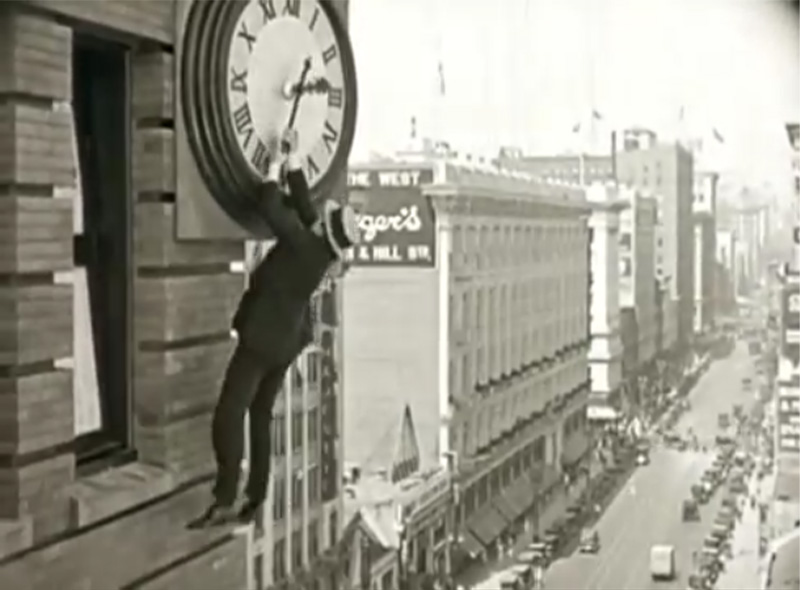
Now all fans know that “in real life” Doc Brown would have died moments earlier from his Harold Lloyd (see image above) impression. But the movie does not take that dark path. Instead, an exhausted, mildly-electrocuted Doc sits on the ground feet away from a Rube Goldberg machine traveling at 88 mph.
Now, 70 years after the fact (or more likely fiction), Altair® MotionSolve® is going to prove, once and for all, how much danger Doc Brown is in.
The Approach
Altair MotionSolve is a multibody dynamics (MBD) software used by engineers around the world to simulate the motion, forces, and dynamics of complex systems. For instance, an automotive engineer could use the tool to predict and optimize the performance and even validate the safety of a car’s brake systems. Instead of testing a car’s brakes, or an aircraft’s landing gear, it’s used here to recreate the time machine, its lightning hook, and the electrified cable to assess the realism of the system.
The simulation will determine and evaluate the forces involved within this system to assess if anything is likely to fail. Will the hook pull out of the Delorean and safely remain on an intact wire? Or will the impact lead to any of the following failure modes?
- The lightning hook breaking.
- The cable snapping.
MotionSolve will find the answer.
Assumptions
Counterintuitively, to assess if the hook breaks or the cable snaps, the simulation must be modeled as if they survive. With this assumption, the forces predicted in the simulations can be compared to the ultimate strength of these objects. If the forces are greater, the parts are likely to fail.
Notably, if these parts survive, then the simulation will also show the likely motion of the hook. This can be used to assess if the hook safely detaches from the time machine.
To recreate the events, a substantial amount of information is required about the cable, hook, and time machine. Due to the lack of available information, close inspection of the movie was required. After all the popcorn, educated guesses based on engineering best practices, material properties, and 1955 technology resulted in the following assumptions:
- The hook’s geometry, construction, and material properties.
- The cable’s geometry and material properties.
- The cable’s preload and boundary conditions.
- The hook-cable frictional properties.
- The hook holder geometry and material properties.
- The hook-holder frictional properties.
Additional assumptions were made to simplify the computations behind the simulation. First, the cable was assumed to be a series of polybeams with circular cross-sections. Modeling a flexible, braided cable is infeasible in MBD and this simplification should yield comparable results. Second, it was assumed that all components, except the cable, are rigid.
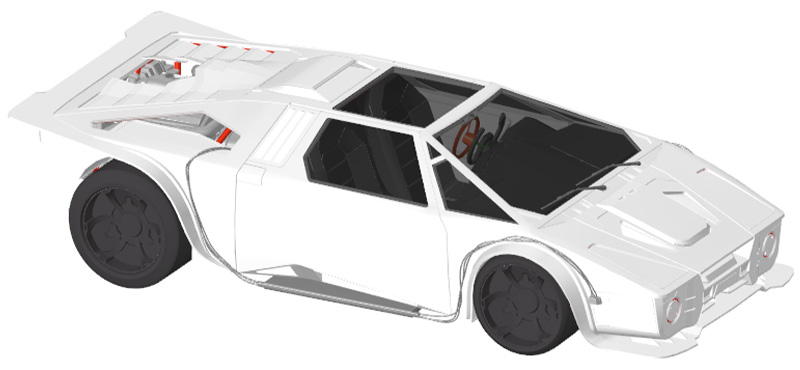
A final change was made to the vehicle. Though completely cosmetic, the time machine gets a 2025 remodel to help celebrate the film’s 40th anniversary.
Results
Would the hook safely detach from the time machine if all goes to plan?
Since the simulation assumes all parts of the system stay intact, it may be easiest to answer if the hook safely detaches from the car. Assuming the hook and cable survive, the answer appears to be: Yes.
After recreating the event in Altair MotionSolve, the simulation shows the hook pulling out of its holster and catching on the cable. The hook then spins around the cable due to its large momentum. After several revolutions, the hook safely clangs to the ground far from Doc Brown.
Would the hook yield or break?
A typical approach for analyzing stress and modeling the flexibility of a part is to use a Craig-Bampton flex-body. However, flex-bodies are built on the assumption that stress vs strain is linear, which is an invalid assumption in this model. Flex-bodies also do not provide a way to display the failure of a component.
An alternative approach is to perform hand calculations, with a factor of safety, to account for the dynamic loading and nonlinear material behavior of the hook. The force in the hook can be monitored, in the simulation, to calculate the peak stress at each timestep. Once the peak stress goes above the yield (with its factor of safety) the hook can be assumed to fail.
After performing these computations on the hook during simulation, it is shown that the stress in the hook exceeds its yield strength once the cable goes taut. This indicates that the hook will begin yielding, and likely fail, as it is pulled out of the holder.
Would the cable snap?
Cables have published breaking strengths. A 3/8” 7x19 stainless steel cable fails at 12,000 lb-force or about 53,000 N. As the cable goes taut, the tension in the cable exceeds its ultimate strength. Therefore, it is also likely that the cable would snap.
Conclusion: A Time Paradox!
Though recreating the climax of Back to the Future in MotionSolve shows the hook will safely detach from the time machine — if all parts remain intact — the forces involved show a frightening reality. More likely, the immediate area would be at risk from the hook’s debris. Worse yet will be the danger from the steel cable whipping around the vicinity at deadly speeds.
Since Doc Brown is so close to the action his chances of survival are slim. He may be lucky and miss the debris. But that metal whip is a different story. Though the cable snapping cannot be demonstrated in MotionSolve, it can be assumed that Doc Brown is out of time.
So, if physically accurate, the movie would end in a chain reaction of time paradoxes that undo the space-time continuum resulting in the destruction of “at-least” our home galaxy. With that cheerful note, happy 40th Anniversary Back to the Future fans!