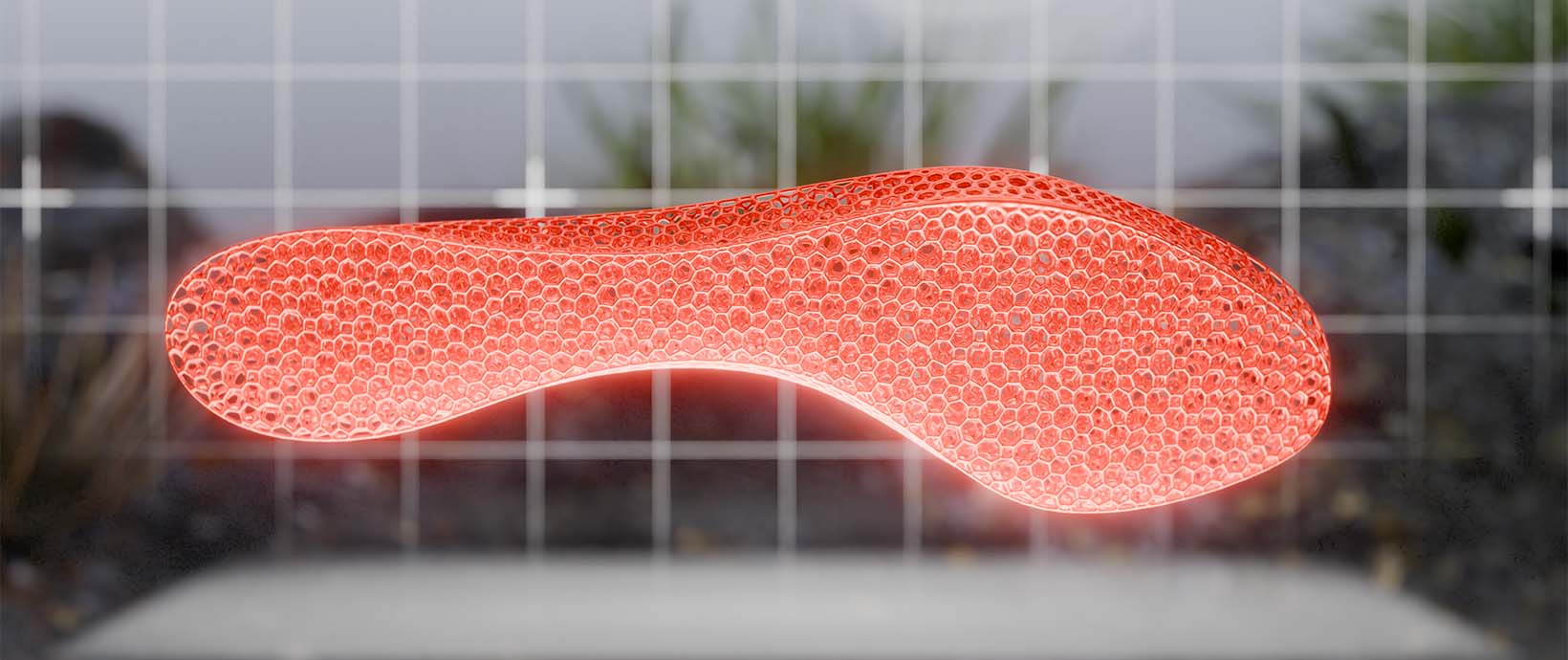
Unlock Next-Generation Simulation with NVIDIA, Microsoft, and Altair
At the intersection of cloud innovation, GPU acceleration, and multiphysics expertise, NVIDIA, Microsoft, and Altair are redefining what’s possible in engineering simulation. This powerful alliance empowers customers to accelerate product development with scalable compute on Microsoft Azure, industry-leading performance from NVIDIA Tensor Core GPUs, and GPU-optimized solvers from Altair. The result: faster insights, reduced costs, and a seamless path to AI-enhanced, high-fidelity simulation at scale.
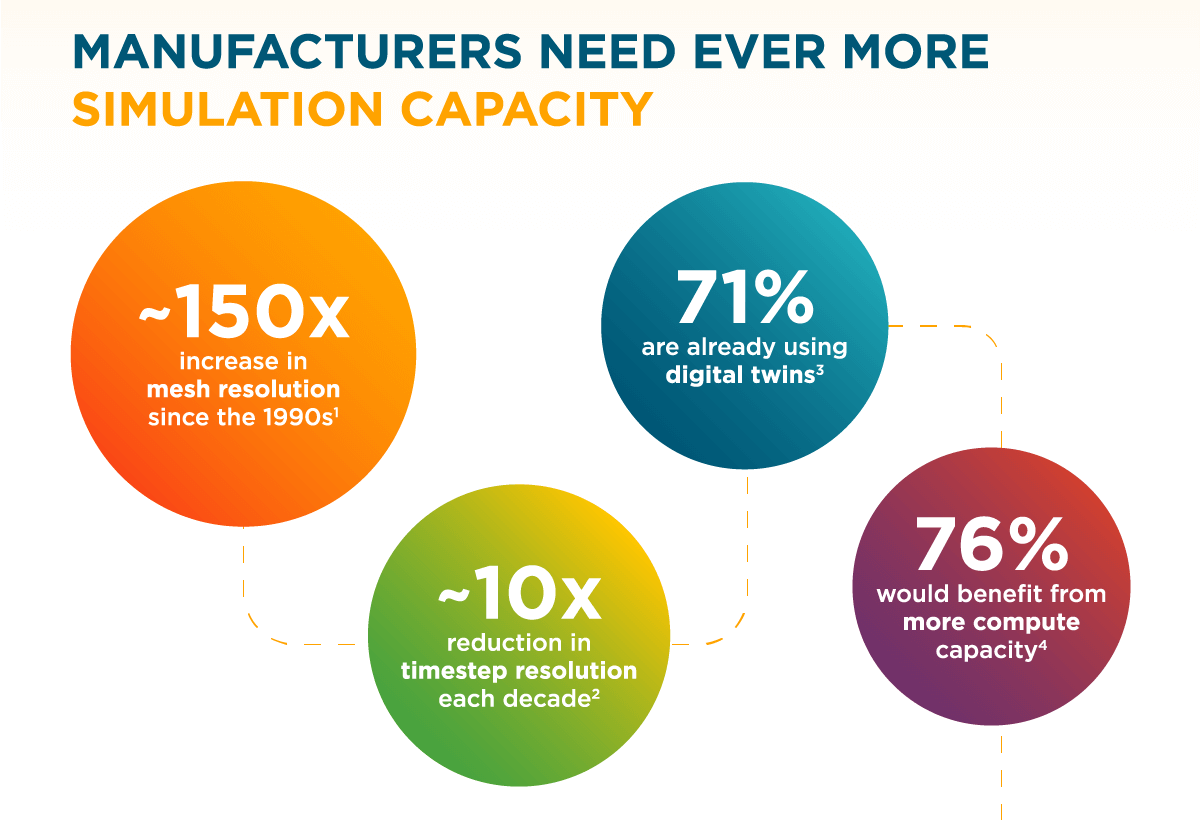


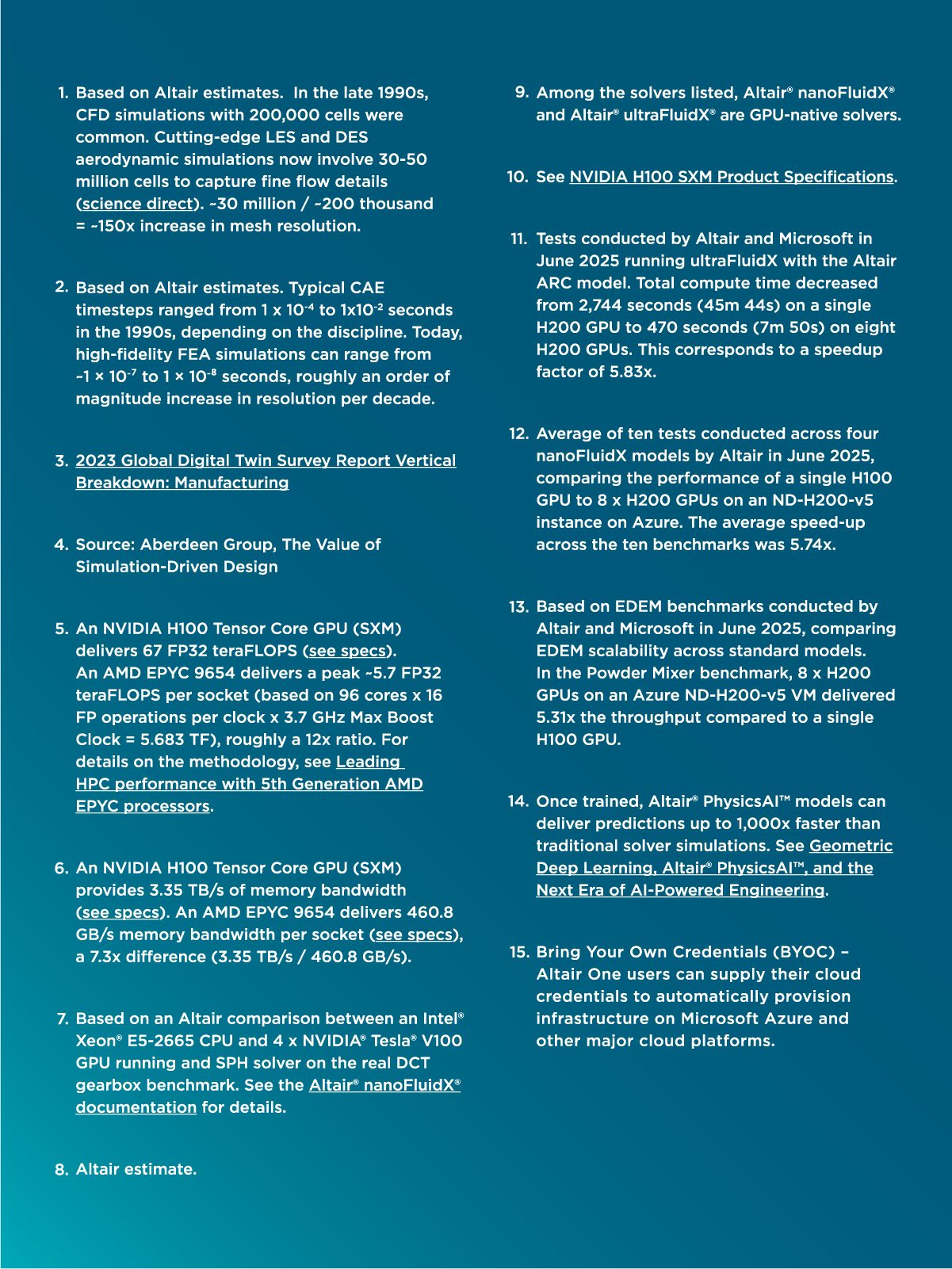
1. Based on Altair estimates. In the late 1990s, CFD simulations with 200,000 cells were common. Cutting-edge LES and DES aerodynamic simulations now involve 30-50 million cells to capture fine flow details (science direct). ~30 million / ~200 thousand = ~150x increase in mesh resolution.
2. Based on Altair estimates. Typical CAE timesteps ranged from 1 x 10⁻⁴ to 1x10⁻² seconds in the 1990s, depending on the discipline. Today, high-fidelity FEA simulations can range from ~1 ? 10?? to 1 ? 10?? seconds, roughly an order of magnitude increase in resolution per decade.
3. 2023 Global Digital Twin Survey Report Vertical Breakdown: Manufacturing
4. Source: Aberdeen Group, The Value of Simulation-Driven Design
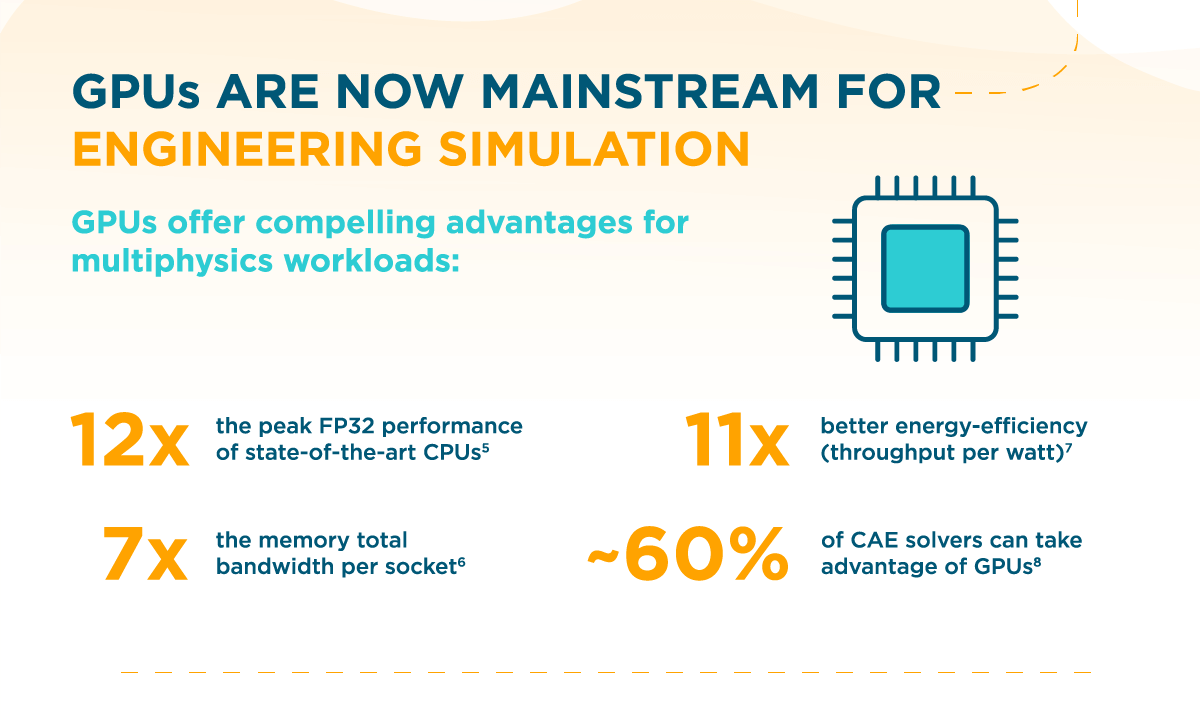
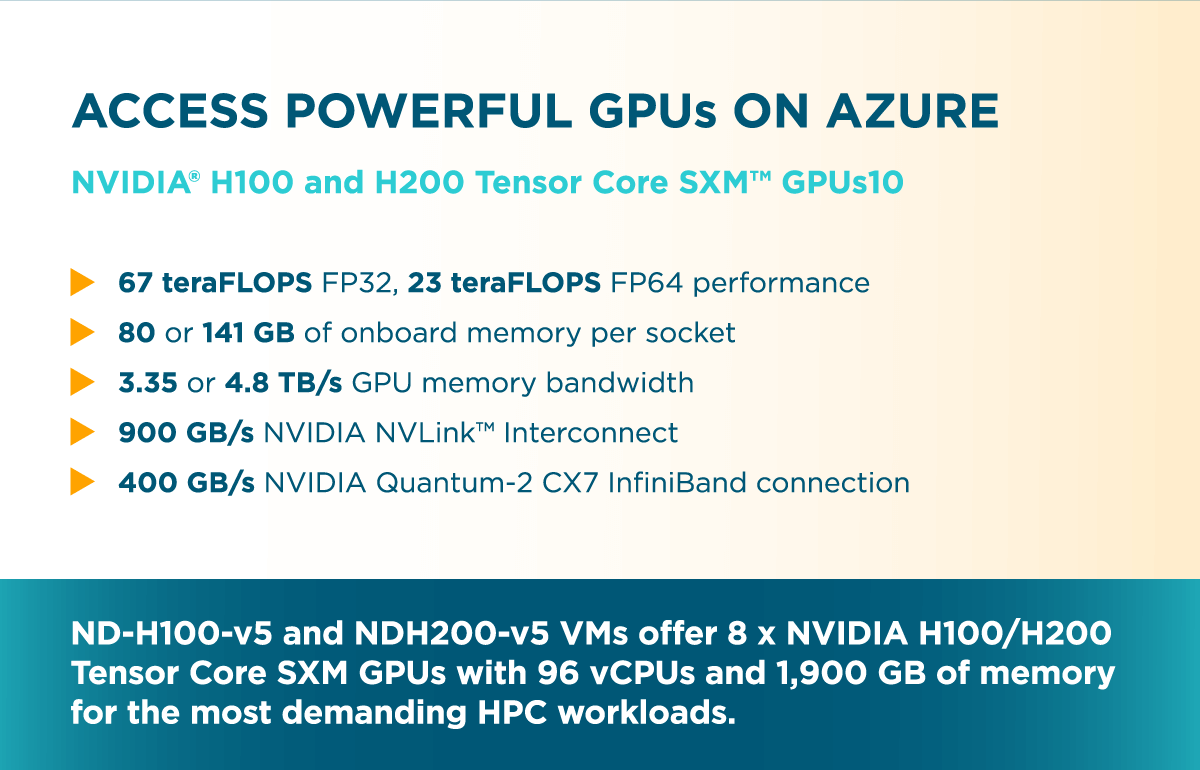
5. An NVIDIA H100 Tensor Core GPU (SXM) delivers 67 FP32 teraFLOPS (see specs). An AMD EPYC 9654 delivers a peak ~5.7 FP32 teraFLOPS per socket (based on 96 cores x 16 FP operations per clock x 3.7 GHz Max Boost Clock = 5.683 TF), roughly a 12x ratio. For details on the methodology, see Leading HPC performance with 5th Generation AMD EPYC processors.
6. An NVIDIA H100 Tensor Core GPU (SXM) provides 3.35 TB/s of memory bandwidth (see specs). An AMD EPYC 9654 delivers 460.8 GB/s memory bandwidth per socket (see specs), a 7.3x difference (3.35 TB/s / 460.8 GB/s).
7. Based on an Altair comparison between an Intel® Xeon® E5-2665 CPU and 4 x NVIDIA® Tesla® V100 GPU running and SPH solver on the real DCT gearbox benchmark. See the Altair® nanoFluidX® documentation for details.
8. Altair estimate.
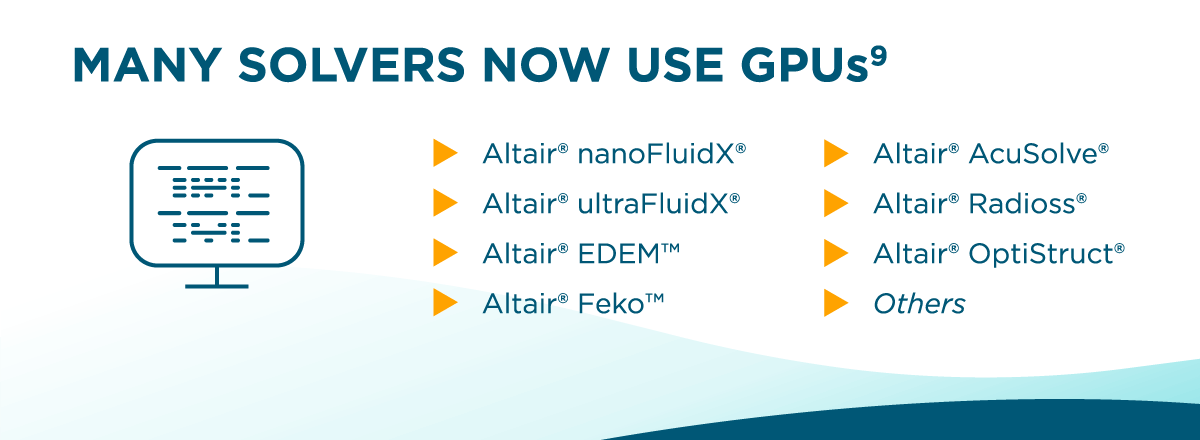
9. Among the solvers listed, Altair® nanoFluidX® and Altair® ultraFluidX® are GPU-native solvers.
10. See NVIDIA H100 SXM Product Specifications.
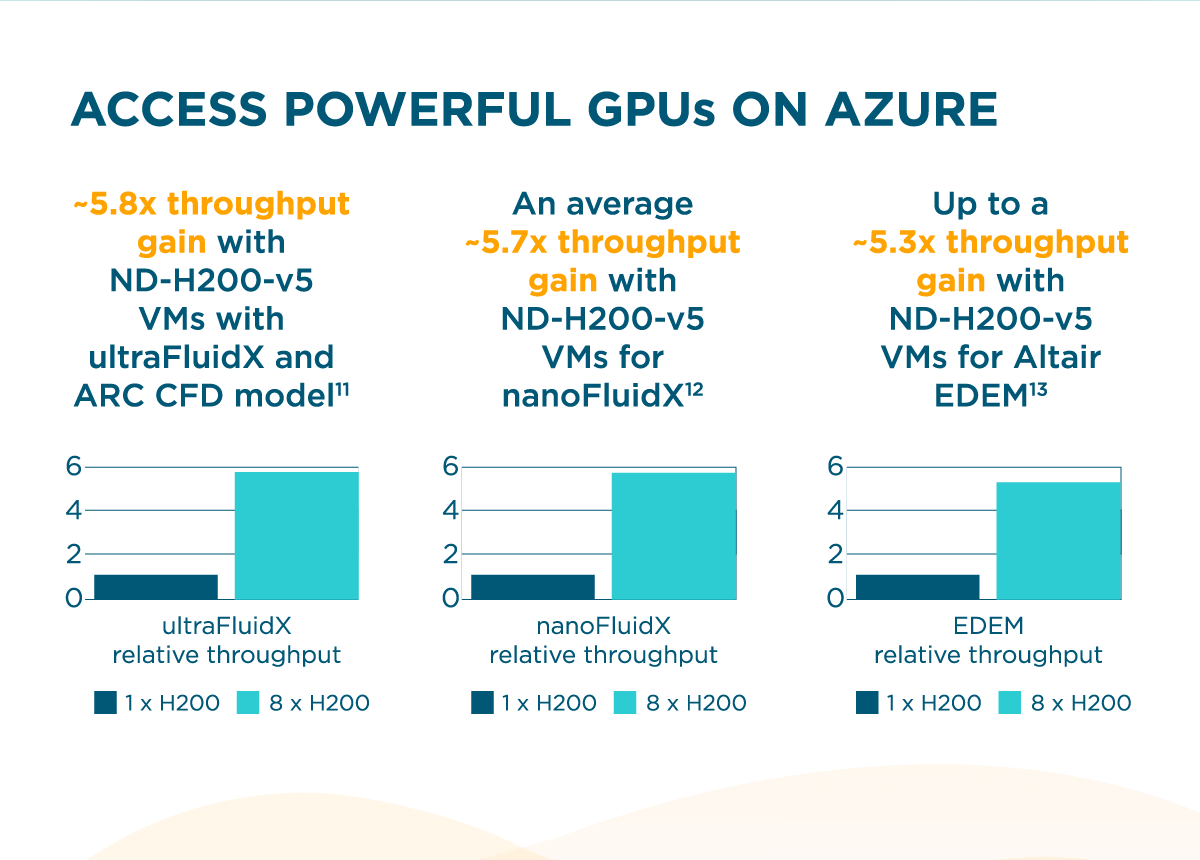
11. Tests conducted by Altair and Microsoft in June 2025 running ultraFluidX with the Altair ARC model. Total compute time decreased from 2,744 seconds (45m 44s) on a single H200 GPU to 470 seconds (7m 50s) on eight H200 GPUs. This corresponds to a speedup factor of 5.83x.
12. Average of ten tests conducted across four nanoFluidX models by Altair in June 2025, comparing the performance of a single H100 GPU to 8 x H200 GPUs on an ND-H200-v5 instance on Azure. The average speed-up across the ten benchmarks was 5.74x.
13. Based on EDEM benchmarks conducted by Altair and Microsoft in June 2025, comparing EDEM scalability across standard models. In the Powder Mixer benchmark, 8 x H200 GPUs on an Azure ND-H200-v5 VM delivered 5.31x the throughput compared to a single H100 GPU.
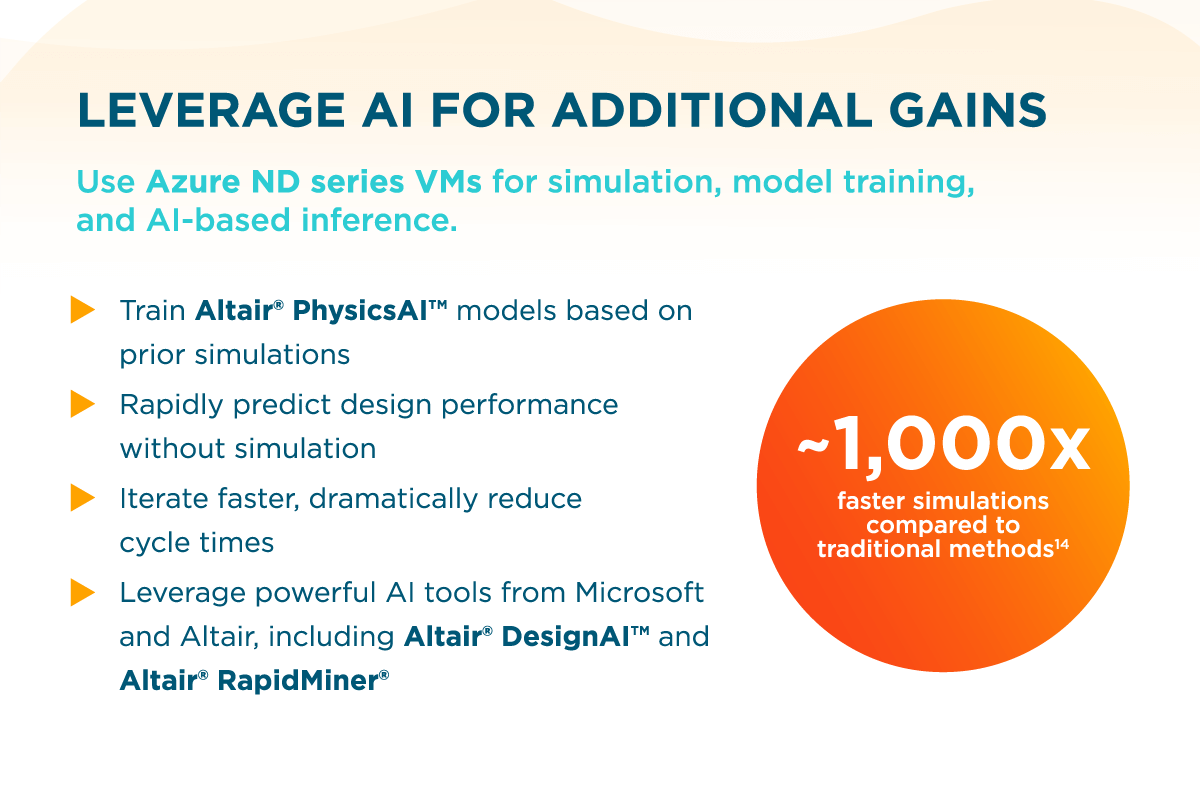
14. Once trained, Altair® PhysicsAI™ models can deliver predictions up to 1,000x faster than traditional solver simulations. See Geometric Deep Learning, Altair® PhysicsAI™, and the Next Era of AI-Powered Engineering.
15. Bring Your Own Credentials (BYOC) – Altair One users can supply their cloud credentials to automatically provision infrastructure on Microsoft Azure and other major cloud platforms.