
CENOS: Wireless Charging by CENOS

Specialized Simulation Software for Wireless Power Transfer Systems

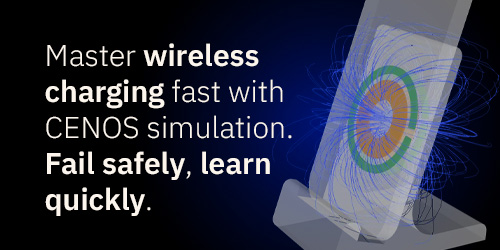
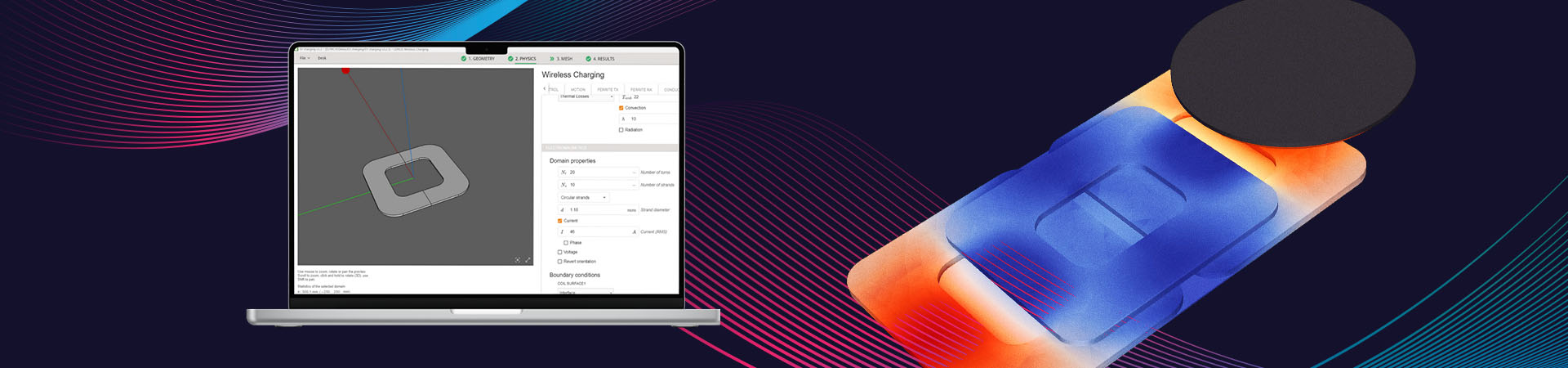
CENOS: Wireless Charging helps engineers design wireless power transfer systems for electric vehicles, industrial robots, consumer electronics – and beyond – with Qi and Qi2 standards supported. As a specialized and intuitive tool, it can be used by engineers without special training in simulation. First, the user imports a CAD model of their system. Then, the software allows users to define physical and process parameters tailored to wireless charging applications. CENOS: WCH generates automatic mesh, and users can manually modify it if necessary. Finally, results can be reviewed by engineers to make further design decisions. For iterative design validation, users can easily replace CAD files in the simulation and re-run calculations with a single click.
Why CENOS: WCH?

Save Design Time and Costs

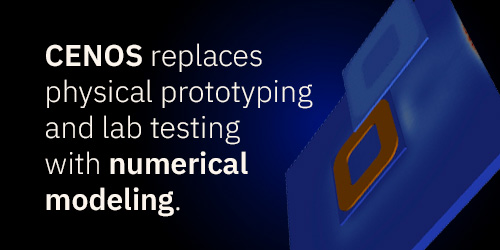
Simulation software replaces physical prototyping and lab testing with numerical modeling. With CENOS: WCH, users can set up simulations in no time.

Design Advancement

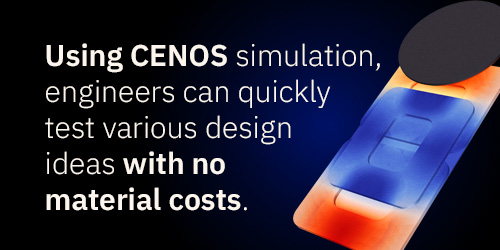
Through simulation, engineers can quickly test design ideas with no material costs – achieving cost-efficient design advancement.

More Insight, More Control

Simulation software replaces decades of process experience, allowing new engineers to quickly learn quickly the induction heating process.

Key Features

Coupling with Electric Circuit

Integrates with LTspice software.

Parametric Study

Allows users to simulate various positions of transmitter and receiver coils against each other (misalignment studies).

Advanced Stranded Coils Definition

Suitable for varieties of design, including circular and rectangular strands.

Automatic Meshing

Numerical mesh is generated automatically; users can leverage the built-in interface for manual refinement of mesh parts.

Powerful Results Analysis

A results analysis tool that includes tools for mutual inductance, coupling efficiency, Q factor, temperature on coil and surrounding objects, and more.

Multi-Thread Parallelization Controls

Fast calculations maximize users’ computer resources.